


Assistant, project manager, or event agency: who should really be responsible for your event to ensure it delivers results?
May 26, 2026
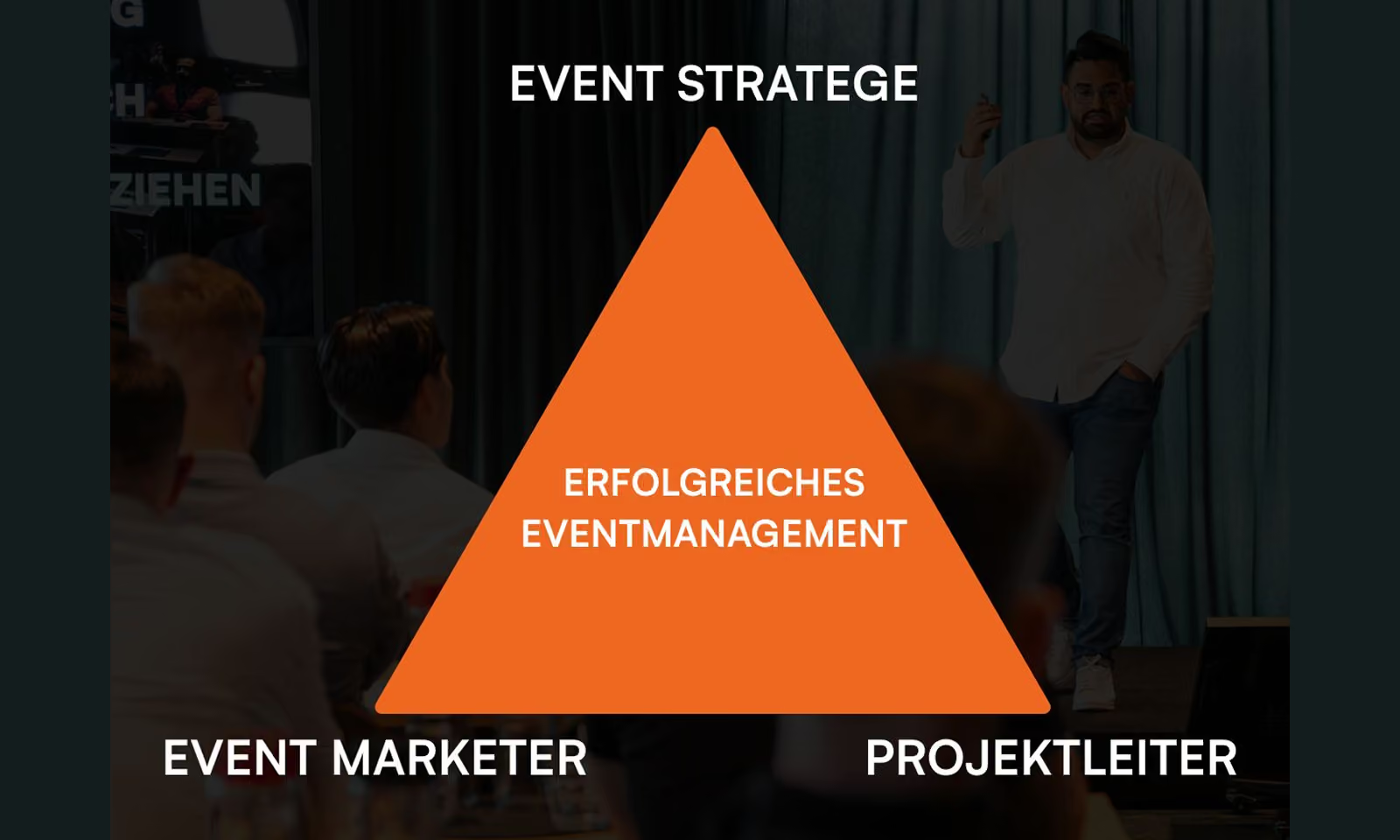
Your event requires three roles: execution, strategy, and marketing. An assistant or internal project manager can often handle the execution, but strategy and marketing are distinct areas of expertise. As soon as your event is intended to measurably influence revenue, leads, recruiting, or customer retention, you need at least one strong internal project lead plus external or internal specialized expertise for concept and marketing.
The three roles that make an event successful
1. Event Manager (Execution)
This is the operational project lead. They break an event down into trades, timelines, tasks, and responsibilities, manage deadlines, coordinate service providers, and ensure that attendees get from A to B without chaos.
Typical areas of expertise:
- Project structure, task logic, time management
- Service provider management and coordination of trades
- Logistics, scheduling, risk management
- Problem-solving under pressure
2. Event Concept or Strategy
This is the role that prevents your event from becoming just a string of agenda items. This is where decisions are made regarding what the event should achieve, who it is for, what message should resonate, and what journey the attendees will experience.
Typical areas of expertise:
- Clearly defining goals and target audiences
- Structuring content and dramaturgy for maximum impact
- Analyze data, feedback, and audience insights
- Select formats that support your goals
- Decide what not to include
3. Event Marketer
This is the role responsible for ensuring people actually attend. Not just eventually, but on time, in the right numbers, and with the right expectations. This role focuses on buying behavior, triggers, scarcity, social proof, landing pages, email sequences, and channels.
Typical areas of expertise:
- Ticket journey and conversion logic
- Landing pages, visuals, ads, and email marketing
- Social media mechanics and content planning
- Coordination with sales, sponsorship, and partners
- Campaign management right up until the event
Why assistants or project managers often fail, despite being talented
Most internal roles don't fail due to a lack of hard work, but due to role overlap. When one person is expected to handle planning, concept, and marketing simultaneously, three typical effects occur:
- The event is over-organized but lacks a sharp position
- Content is collected, but not built for purpose and impact
- Marketing starts too late because organization consumes all the time
The result is an event that looks good on paper but doesn't feel like a driver for growth. This is exactly why you hear comments afterward like: The food was good, the atmosphere was nice, but what did it actually achieve?
The most important decision: Do you want to host an event or generate results?
This is the question you should answer honestly internally before filling any roles.
If you only want to host an event
In these cases, a strong assistant or a capable internal project manager is often sufficient, provided the event is small, expectations are straightforward, and there is no significant pressure to deliver ROI. Typical examples include internal team events or smaller client gatherings without ambitious growth targets.
If you want to generate results
Then concept and marketing must be integrated from the start; otherwise, you will end up with a well-organized event that lacks impact. In practice, results mean: leads, conversion rates, pipeline, retention, employer branding, or positioning that pays off in the market later on.
Decision factors: When does it become risky for an assistant?
1. Budget and risk
As soon as you make a significant investment, expectations and pressure increase. The more relevant question then is no longer whether the event will take place, but whether it will be effective.
2. Demand for impact
If you can define which metric you want to change, you also need someone who knows how to influence that metric through an event. That is strategy, not organization.
3. Marketing is relevant
As soon as tickets are being sold or participants need to be actively acquired, event marketing becomes a specialized field. An assistant can provide support, but without experience in conversion mechanics, the approach often becomes too late, too generic, or insufficiently segmented.
4. Multiple stakeholders and complex messaging
The more internal coordination required, the higher the risk that the event will end up being a compromise. The strategy role must then actively force decisions, otherwise the concept will become diluted.
5. Demanding participant profile
If you are targeting CEOs, decision-makers, or VIP audiences, standard communication is rarely enough. This requires exclusivity, clear positioning, and a setup that respects their time.
Concrete setup models that work in practice
Setup A: Internal project lead plus external concept and marketing power
For many mid-sized companies, this is the most efficient solution. You provide an internal person to coordinate decisions and lead the project, and bring in external expertise for concept and marketing to ensure the event not only takes place but also delivers results.
Advantage: Internal relief, clear roles, less friction, and better results.
Setup B: Internal project lead plus an external agency covering all three roles
This makes sense if the event is larger, requires many different services, and internal capacity is limited. It is crucial here that the agency actually covers concept, marketing, and execution, rather than just project management.
Benefit: One center of responsibility, fewer interfaces, clear accountability.
Setup C: Internal team with clear roles
This works if you truly have specialists in-house. Not one person doing everything, but a setup consisting of project management, marketing, and someone who can provide conceptual leadership.
Benefit: Fully in-house, but only makes sense if the expertise is actually there.
Practical example from 320+ projects
We regularly see cases where an assistant prepares an event perfectly from an organizational standpoint, but the project falters the moment conceptualization and marketing come into play. The agenda becomes too crowded, the messaging too soft, and marketing starts late because the organization takes up all the bandwidth. In these exact cases, the solution is often not a new tool, but a change in roles: have a strong internal project lead and integrate external conceptual and event marketing support so that the event is not just planned, but led.
{{callout}}
Checklist: How to verify if your setup is right
Answer these questions honestly:
- Who makes the final decision when conflicts arise?
- Who is responsible for ensuring the event has a clear message?
- Who ensures that the right people attend?
- Who measures success, and who uses that data to build the next iteration?
- Who has the time to truly lead the project, rather than just managing it on the side?
If you don't have a clear answer for two or more of these points, your setup is not stable.
Conclusion
An assistant can plan an event. They can also organize many things excellently. But organization is not what makes an event successful if you are looking for results.
A successful event is built on three roles: execution, conceptualization, and marketing. As soon as your event needs to have a strategic impact, you either need these roles in-house or a partner who covers them. Otherwise, you will almost always get the same result: a lot of effort, an event that was somehow nice, and the subsequent question of why the budget is being debated again next year.
Role and setup check for your event
If you are currently considering whether your next event should be organized internally or if it is time for external support, a quick setup check is worth your time.
Together, we will examine:
- what goal your event is truly intended to achieve
- which of the three roles are currently covered in your team
- where you are at risk because tasks are being blurred
- which setup is most efficient for your budget and capacity
If you like, send us a brief overview of your event type, objectives, number of participants, and current internal resources. We will then provide you with a clear recommendation on how to structure your event to ensure it delivers results without leaving everything on one person's shoulders.
Häufig gestellte Fragen
At what point does it no longer make sense to organize an event in-house?
Can an assistant still play a central role?
How do I know if my event concept is too weak?
What is the biggest difference between event management and event marketing?
How do I properly integrate concept and marketing?
Über den Autor

Kevin Arenja
CEO
Kevin Arenja is founder and managing director of KPlusa Communications. As TÜV-certified expert in sales psychology, lecturer in event management At THM Technische Hochschule Mittelhessen and IHK examiner, he brings deep Expertise and over 12 years of industry experience with — from strategic roadshows to sales events to international events with up to 3,500 guests. After a B.A. in Media and Event Management, one MBA in Business Administration and his Apprenticeship as an event manager Did Kevin well over 320 projects implemented for corporations, medium-sized companies and hidden champions. His mission: Events measurably successful to do — with emotional relevance, clear strategy and an eye for what really works.
Weitere interessante Artikel
This is how you build an event agenda that measurably increases revenue and motivation
An event agenda is not a schedule.
It is a sales tool.
If your agenda merely strings together program items, you'll get applause for the catering. But no results.
If your agenda is psychologically structured, you'll get leads, motivation, clarity, or revenue.
So the question is not: Which speakers should we book?
The question is: What thought process should your attendees go through?


Events as a marketing lever: How to deploy the right format at the right stage and measurably increase sales and retention
Many companies organize events too early, too vaguely, or without proper integration into marketing and sales. You know the result: good food, pleasant conversations, no impact.
If you want to use events as a tool, you don't need a new list of ideas. You need a decision: In which phase of customer acquisition or retention should the event have an impact, and which format precisely contributes to that goal.
This article provides you with a clear model that allows you to decide in 15 minutes whether an event is currently worthwhile, which format fits, and which mistakes you need to avoid.

The Campfire Matrix: How to design events that are memorable and drive more conversions
Many events end up feeling the same. You were there. You ate. You shook a few hands. And two weeks later, no one remembers what it was about.
If you truly want your event to make an impact, you don't need a bigger budget. You need a system that prevents your event from falling apart conceptually.
The Campfire Matrix is exactly that system. It ensures that your event isn't just pleasant, but creates memories and delivers results.