


This is how you build an event agenda that measurably increases revenue and motivation
July 9, 2026
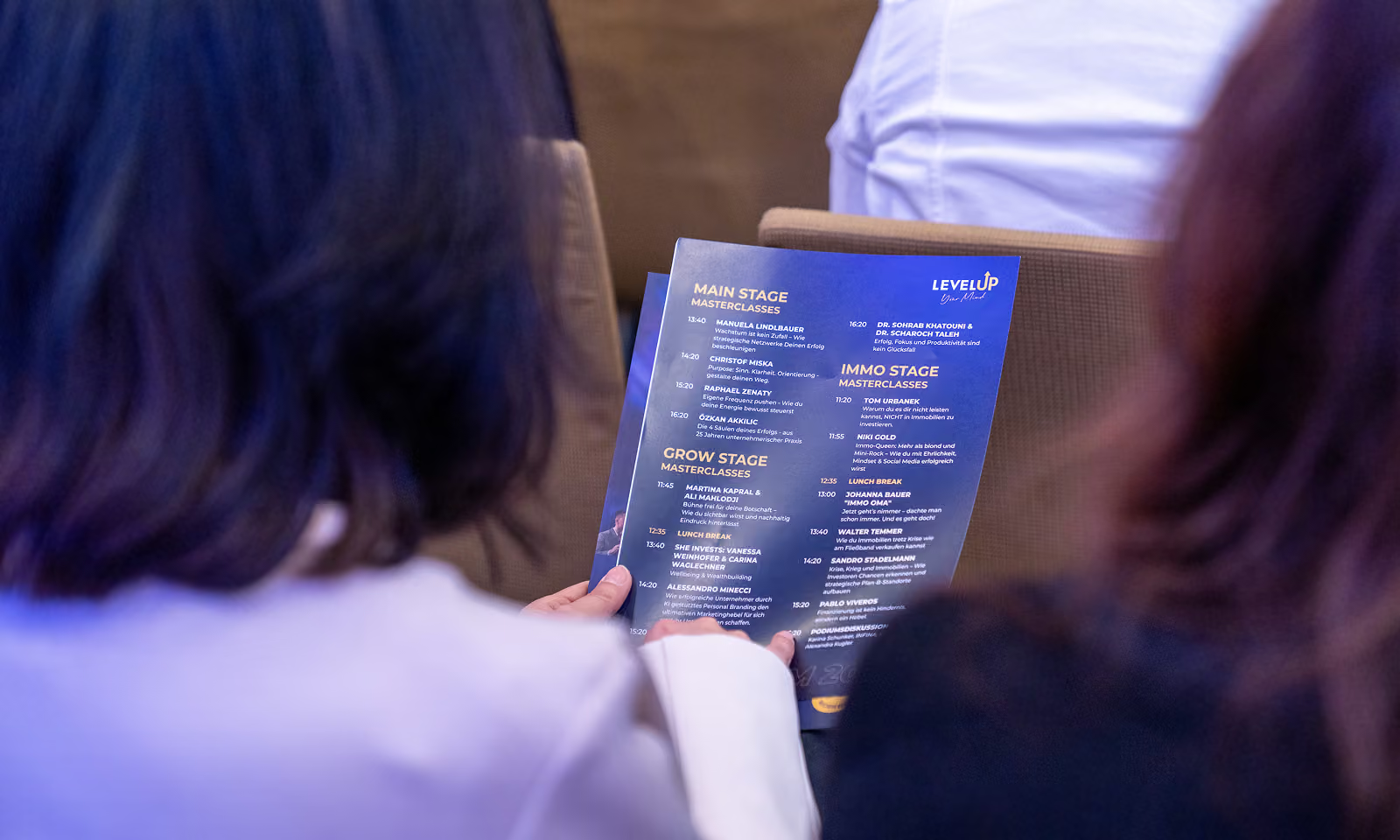
An effective event agenda follows a clear dramaturgy:
- Raise awareness of the problem
- Show that a solution is possible
- Compare solution approaches
- Debunk wrong approaches
- Logically position your own solution
Only then do you plan times, breaks, and speakers.
What a strong event agenda truly is
A strong event agenda is the targeted management of attention, expectations, and decision-making processes.
An event rarely fails due to budget.
It fails due to a lack of dramaturgy.
Step 1: Clarify expectation management before you plan
Before you even define a single program item, you must answer three questions:
- Why do people register?
- What mindset do these individuals bring?
- What exactly do they expect?
Example:
A software company promotes an event showcasing new features.
Then attendees expect exactly that. No general market analysis. No corporate image presentation.
The agenda must deliver on the promise made in the marketing and invitation.
Step 2: Define goals – with an economic focus
Many events are planned without a clear return on investment.
Ask yourself specifically:
- Are you investing 30,000 Euros?
- 100,000 Euros?
- 500,000 Euros?
Then you need to answer:
- What changes do you expect afterwards?
- More revenue?
- Higher conversion rate?
- Motivated employees?
- Faster implementation of new processes?
Only once you know your goal can you develop an agenda that contributes to it.
Step 3: The 5 Narrative Blocks
We structure agendas into five conceptual stages.
1. Highlight the problem
Participants must recognize their own problem.
Not abstract. Specific.
Involve Sales, Customer Service, or Key Account Managers. They know exactly where the issues lie.
2. Normalize the problem
Many think: “This is just us.”
Show:
Others have the same issue.
This reduces resistance.
3. Demonstrate solvability
This creates hope.
“This problem is solvable.”
4. Compare solution paths
- Path A is expensive
- Path B is slow
- Path C is inefficient
This provides clarity.
5. Logically position your solution
Now, your solution.
Not as advertising. But as a logical consequence.
If you execute this process flawlessly, your conversion rate will increase significantly.
{{callout}}
Step 4: Actively manage attention
Average attention span in presentations: a few minutes.
Specifically:
- No monotonous 45-minute monologue
- A change of stimulus every 8 to 9 minutes
- Vary media
- Change of perspective
- Interaction
- Humor
- Provocative question
Two purely technical speakers back-to-back?
Almost always a mistake.
Change your energy level and presentation style.
Checklist: How to maintain consistent attention
- Alternating between energetic and analytical speakers
- Maximum 45 minutes per slot
- After 90 to 150 minutes break
- Plan for media changes
- Integrate interaction
- Brief speakers clearly
Step 5: Breaks are not downtime
Many shorten breaks to fit in more content.
Mistake.
Participants have three core motivations:
- Networking
- Learning
- Having fun
Lunch breaks, in particular, are networking opportunities.
We often recommend:
- 90 minutes for lunch instead of 60
- Flexible adjustment based on the energy in the room
Sometimes an extended break generates more business than an additional presentation.
Practical example from a sales event
A client was planning a traditional sales conference.
Agenda:
- Numbers
- Product Updates
- Figures
- Strategy
- Figures
Previous Years' Results:
Low motivation, little implementation.
We changed the dramaturgy:
- Starting with customer feedback
- Problem clusters from a sales perspective
- Best Practice Case
- Interactive exchange
- Product solution as a response
Result:
- Higher participation
- More concrete implementation plans
- Significantly more positive feedback scores
- Demonstrably better sales conversion rate in the following quarter
The difference wasn't the budget.
It was the dramaturgy.
Step 6: Realistically assess resources
An agenda is only as good as its execution.
Ask:
- Can the venue technically accommodate media changes?
- Is there enough space for networking?
- Do you have the right speakers?
- Is there buffer time?
- Can catering be seamlessly integrated logistically?
If resources are lacking, the event's flow must be adjusted.
Step 7: Speaker briefing is mandatory
Many events lose impact due to unchecked speakers.
Clear rules:
- Clear time limit
- Visible timer
- Expected interaction points
- Change of stimulus every 8 to 9 minutes
- Clear objective for the presentation
Without a briefing, there's no effective flow.
Common mistakes in event agendas
- Too many program items
- No clear definition of objectives
- Monotonous speaker order
- Breaks are too short
- No expectation analysis
- No external perspective
If you are unsure, have two external people review your agenda.
Not just internally.
Conclusion
A good event agenda is not created in Excel.
It is created from:
- Clear objectives
- Understanding of the problem
- Psychological dramaturgy
- Active attention management
- Clear resource planning
If you invest 100,000 Euros, the agenda cannot be the weakest part of your event.
Would you like to have your agenda reviewed?
If you have already developed an agenda or are currently planning one, we would be happy to review it with you for:
- Clear objectives
- Dramaturgy
- Attention guidance
- Conversion Potential
In a compact agenda audit, you will receive concrete optimization recommendations.
Häufig gestellte Fragen
What is the most common mistake with event agendas?
How long should a presentation block last?
Are longer lunch breaks beneficial?
How important is the speaker briefing?
Should an agenda be reviewed externally?
Über den Autor

Maximilian Schmidt
Event Management
As a project manager at KplusA, Maximilian is responsible for the holistic implementation of events, from conception to organization and follow-up. As a trained event manager, he has already implemented over 50 projects — from exclusive customer events to complex trade fair appearances. Whether it's location research, technology, catering, set-up or on-site direction: Maximilian ensures that everything happens in the right place at the right time.
His mission: manage events efficiently with an eye for detail and an absolute hands-on mentality and lead them to success with a clear structure.
Weitere interessante Artikel

Events as a marketing lever: How to deploy the right format at the right stage and measurably increase sales and retention
Many companies organize events too early, too vaguely, or without proper integration into marketing and sales. You know the result: good food, pleasant conversations, no impact.
If you want to use events as a tool, you don't need a new list of ideas. You need a decision: In which phase of customer acquisition or retention should the event have an impact, and which format precisely contributes to that goal.
This article provides you with a clear model that allows you to decide in 15 minutes whether an event is currently worthwhile, which format fits, and which mistakes you need to avoid.


The Campfire Matrix: How to design events that are memorable and drive more conversions
Many events end up feeling the same. You were there. You ate. You shook a few hands. And two weeks later, no one remembers what it was about.
If you truly want your event to make an impact, you don't need a bigger budget. You need a system that prevents your event from falling apart conceptually.
The Campfire Matrix is exactly that system. It ensures that your event isn't just pleasant, but creates memories and delivers results.
How to turn an event into a content machine: Plan for social media before, during, and after the event
Most companies think of event content as an aftermovie. A nice video, a short-lived peak, and that's it.
The problem: An aftermovie rarely sells tickets, rarely books appointments, and almost never builds trust. It's a memory, but not a machine.
If you use social media correctly, your event becomes a content source for weeks, sometimes months. Before the event for registrations, during the event for reach and FOMO, afterwards for follow-up business, applications, or the next event.
Here's the clear plan.
