


The Campfire Matrix: How to design events that are memorable and drive more conversions
June 24, 2026

An event sticks with people and contributes to revenue or loyalty when three pillars are intentionally planned:
- Networking
- Experience
- Content
Not every pillar needs to be equally strong, but each one must be present. The specific emphasis depends on the goal and format.
Definition: What the Campfire Matrix is
The Campfire Matrix is a planning model that breaks down every event into three core functions:
- Connecting people
- Emotionally engaging people
- Advancing people professionally
An event rarely fails due to the stage. It fails because one of these functions is missing or incorrectly weighted.
Step 1: Understanding why the Campfire works
Think of a real campfire.
People gather.
They share their experiences.
They compare notes.
They learn from each other.
And eventually someone asks the crucial question: How did you do that?
That's precisely the core of a powerful business event. You don't just need agenda items. You need a situation where exchange happens, learning takes place, and emotions resonate.
The 3 Pillars in Detail
1. Networking
Networking isn't accidental. It's about steering.
If you simply offer a break, the loud ones will network with the loud ones. And the relevant people will be overlooked.
Here's how to actively manage networking:
- Matchmaking by industry, role, or problem
- small groups instead of large crowds
- Round tables with a clear guiding question
- moderated discussion formats
- Lounge areas that facilitate conversations
Common mistake:
You expect the right conversations to happen naturally.
Better:
You create formats that compel the right conversations.
2. Content
Content isn't just a lecture.
Many events consist of speaker slots. This often means one-way presentations. And that rarely leads to change.
What works better:
- interactive learning
- Panel discussions with real conflicts
- Live cases instead of theory
- Storytelling instead of PowerPoint monotony
- Q and A formats that allow for genuine objections
Specific mistake:
You have good speakers, but no one takes anything away.
Better:
You plan what attendees should specifically do differently afterwards.
3. Experience
Experience is not decoration. Experience is memory.
If people are to remember your event, you need emotional markers.
These can include:
- Lighting and sound that create atmosphere
- Staging moments
- Surprise elements
- Multisensory experiences, meaning more than just sight and sound
- excellent catering
- Entertainment that aligns with your objective
Specific Error:
You skimp on the experience and then wonder why the event feels interchangeable.
Better:
You strategically place individual, memorable markers.
{{callout}}
5 Criteria: How to find the right balance
The question isn't whether you need all three pillars. The question is: To what extent?
Prioritization Checklist
- What is the event's objective?
Closing, Engagement, Motivation, Positioning - How well do participants already know each other?
The less familiar they are, the more guided the networking needs to be. - How complex is the topic?
The more complex the topic, the more interactive the content needs to be. - How high is the emotional requirement?
The more emotional the objective, the more impactful the experience needs to be. - How large is the group?
The larger the group, the more structure you need for networking.
Practical Examples: How the Matrix Works for Different Event Types
Example 1: Professional Conference or Business Event
Typical Objective: Showcase expertise, nurture leads, facilitate conversations
Recommended Weighting:
- Networking: High
- Content: High
- Experience: Medium
Specific Implementation:
- Round tables with guiding questions instead of just coffee breaks
- Interactive sessions instead of just lectures
- Focused atmosphere, but no show for show's sake
Example 2: Anniversary or Internal Celebration
Typical Objective: Strengthen community, loyalty, and identity
Recommended Weighting:
- Experience: High
- Networking: High
- Content: Low to Medium
Specific Implementation:
- Seating arrangement that encourages interaction
- Photo booth or interactions that build connections
- emotional moments that bring the company's story to life
Example 3: Product Launch or Kickoff
Typical Objective: Acceptance, motivation, clarity, preparing for decisions
Recommended Weighting:
- Content high
- Experience high
- Networking medium
Practical Implementation:
- Product showcase instead of slides
- Hands-on stations for testing
- Dinner or brief discussion for objections and questions
Common mistakes with the Campfire Matrix
Mistake 1: One pillar is completely missing
Example:
You have a lot of content, but no networking. Result: no one talks to each other, no connection, no deals.
Or:
You have show, but little substance. Result: people remember it, but don't trust it.
Mistake 2: Everything equally strong
If you try to maximize everything, it becomes arbitrary and expensive.
Strength comes from focus.
Mistake 3: You only plan the day, not its lasting impact
Once the event is over, the real work of implementation truly begins.
Without follow-up, everything falls apart.
Conclusion
If you want your event to be unforgettable, you need a clear planning model.
The Campfire Matrix provides a pragmatic framework for this:
- Networking fosters relationships and conversations
- Content provides learning and direction
- Experience creates memories and emotions
The specific design is the lever.
When these three pillars align, the following increases:
- Duration of stay
- Engagement
- Memorability
- Conversion rate
- Customer loyalty
Campfire Matrix Check
If you're planning an event and want to ensure it's not forgotten, you can apply the Campfire Matrix to your format in 30 minutes.
Together, we'll explore:
- which pillar is weakest for you
- what configuration makes sense
- which measures will yield quick results
- how to secure the results after the event
If you'd like, briefly send us your event goal, target audience, and a rough outline. We'll then provide a clear assessment of where you should refine your approach.
Häufig gestellte Fragen
What is the Campfire Matrix in one sentence?
Does every pillar need to be equally strong?
How do I know which pillar is missing in our case?
Which pillar has the greatest impact on conversions?
For business events, it's usually the combination of well-facilitated networking and interactive content. What's the most common mistake at business events?
Über den Autor

Kevin Arenja
CEO
Kevin Arenja is founder and managing director of KPlusa Communications. As TÜV-certified expert in sales psychology, lecturer in event management At THM Technische Hochschule Mittelhessen and IHK examiner, he brings deep Expertise and over 12 years of industry experience with — from strategic roadshows to sales events to international events with up to 3,500 guests. After a B.A. in Media and Event Management, one MBA in Business Administration and his Apprenticeship as an event manager Did Kevin well over 320 projects implemented for corporations, medium-sized companies and hidden champions. His mission: Events measurably successful to do — with emotional relevance, clear strategy and an eye for what really works.
Weitere interessante Artikel

This is how you build an event agenda that measurably increases revenue and motivation
An event agenda is not a schedule.
It is a sales tool.
If your agenda merely strings together program items, you'll get applause for the catering. But no results.
If your agenda is psychologically structured, you'll get leads, motivation, clarity, or revenue.
So the question is not: Which speakers should we book?
The question is: What thought process should your attendees go through?


Events as a marketing lever: How to deploy the right format at the right stage and measurably increase sales and retention
Many companies organize events too early, too vaguely, or without proper integration into marketing and sales. You know the result: good food, pleasant conversations, no impact.
If you want to use events as a tool, you don't need a new list of ideas. You need a decision: In which phase of customer acquisition or retention should the event have an impact, and which format precisely contributes to that goal.
This article provides you with a clear model that allows you to decide in 15 minutes whether an event is currently worthwhile, which format fits, and which mistakes you need to avoid.
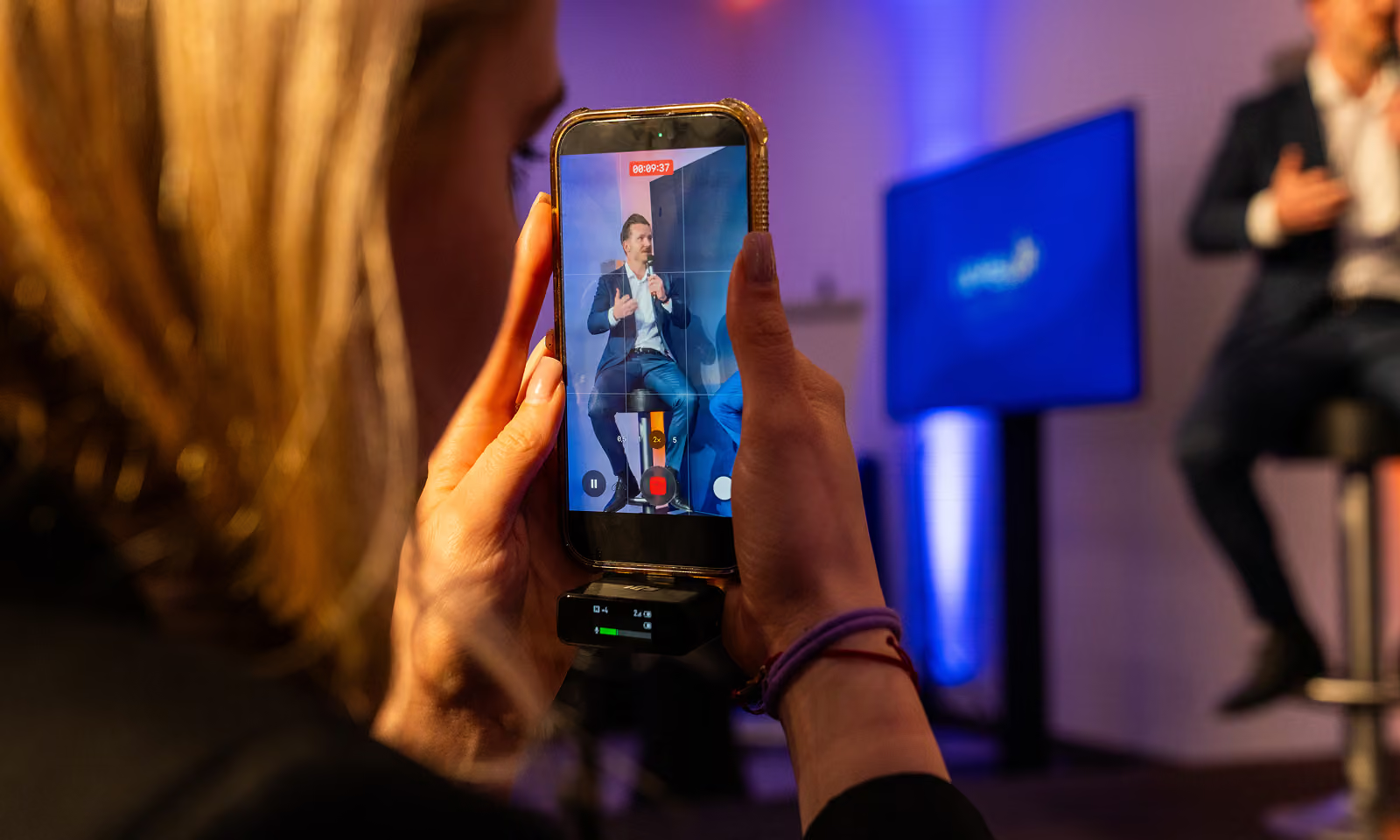
How to turn an event into a content machine: Plan for social media before, during, and after the event
Most companies think of event content as an aftermovie. A nice video, a short-lived peak, and that's it.
The problem: An aftermovie rarely sells tickets, rarely books appointments, and almost never builds trust. It's a memory, but not a machine.
If you use social media correctly, your event becomes a content source for weeks, sometimes months. Before the event for registrations, during the event for reach and FOMO, afterwards for follow-up business, applications, or the next event.
Here's the clear plan.
