


Events as a marketing lever: How to deploy the right format at the right stage and measurably increase sales and retention
July 1, 2026

Only use events when your offer, brand, processes, and sales are running stably. Then, choose the event format not based on preference, but on the phase:
- Awareness
- Trust
- Closing
- Retention
Each phase requires different content, different participants, a different approach, and different follow-up.
What an event should truly accomplish in marketing
An event is an accelerator for relationships.
Online, you can build reach. An event can solidify trust, increase closing probability, and reduce churn, because people meet you in person and emotionally validate their decision.
An event rarely fails because of the location. It fails because it's trying to solve the wrong problem at the wrong time.
Step 1: First, check if events are even worthwhile yet
Before discussing formats, clarify these basic questions:
Checklist: Event Maturity Level
- Do you have an offer that already sells without needing an event?
- Is your positioning clear and repeatable?
- Can you predictably generate leads, organically or through ads?
- Do you have functioning processes for sales, onboarding, and execution?
- Does your team have the capacity to handle content and follow-up effectively?
If you answer no to several of these, an event is often an expensive distraction. In that case, fix the foundation first. Otherwise, the event will be a one-off show with no lasting impact.
Step 2: Position events within your marketing mix, not as a standalone measure
Many plan the event and hope that things will somehow work out afterwards.
Turn it around:
- Which phase of your customer journey is currently stalled?
- Where are you losing prospects?
- Where are processes breaking down?
- Where is churn a risk?
Only then do you choose an event format.
{{callout}}
If your event doesn't have a clear purpose in your journey, it will end up being like a class reunion. Nice, but ineffective.
{{callout}}
Step 3: The 4-Phase Model for Events
Phase 1: Awareness
Goal: Increase visibility among new target audiences
Typical formats:
- Trade show presence (with clear lead logic)
- Sponsoring at relevant industry events
- public expert conference or panel with a clear position
- Webinar as an introductory format, if an in-person event is still too early
Important point: This phase is not about closing deals. It's about initial contact and recognition.
Specific success metrics:
- qualified initial contacts
- Appointment rate after the event
- Cost per Lead compared to pure ads
Common mistake: They try to immediately convert cold contacts at the event into customers. This comes across as aggressive and creates pressure instead of trust.
Phase 2: Trust
Goal: Bring prospects closer to the brand and demonstrate expertise
Typical formats:
- Workshop with a clear problem-solving approach
- Roadshow at the client's site or in regional hubs
- small dinner format for selected contacts
- Community event focused on exchange and guidance
Proximity matters here. Decision-makers need to feel: This is a reputable provider who understands my problem and can guide me.
Specific Success Metrics:
- Number of conversations with decision-makers
- Lead-to-opportunity conversion
- Quality of objections (less distrust, more detailed questions)
Common mistake: Too much show, too little substance. Trust is built through clarity, examples, figures, and real-world cases.
Phase 3: Closing
Goal: Turning serious prospects into paying customers
Typical formats:
- Product demo event with a clear agenda
- Intimate sales event
- Executive Roundtable
- Mastermind format, if the target audience and price point are a good fit
In this phase, the event acts as a decision catalyst. It eliminates risks and simplifies the next step.
Specific Success Metrics:
- Closing rate within 30 days
- Average deal value
- Time to close
Common mistake: The event content is good, but there's no clear next step. No offer, no process, no follow-up.
Phase 4: Retention
Goal: Retain customers, reduce churn, enable upselling and cross-selling, generate referrals
Typical formats:
- Customer Appreciation Day
- Loyalty Club
- exclusive workshop for customers only
- Incentive trip, if economically viable
Especially in subscription models or recurring services, this is often the strongest lever. Acquiring customers is expensive. Retaining customers is profitable.
Specific success metrics:
- Churn rate before and after the event
- Expansion revenue
- Number of referrals
Common mistake: Customers are invited, have a good time, and then nothing happens. Without follow-up, the energy dissipates.
Step 4: Choose the format based on the target audience's openness
A simple decision-making aid:
5 criteria for format selection
- Cold or warm?
Cold leads require low commitment. Warm means a smaller circle and more depth. - Decision Risk
The higher the price or significance, the more impactful a trust-building format is before closing. - Offer Complexity
Complex solutions require explanation, examples, and discussion, not just advertising. - Sales Cycle
A long sales cycle benefits from formats that accelerate intermediate steps. - Existing Customer Base
If you already have many customers, retention is often the fastest ROI.
Practical Example from 500+ Projects
In a challenging market situation, a company wanted to plan a large customer event with the goal of acquiring new customers.
The analysis clearly showed that the bottleneck was not reach, but trust. Many knew the brand but didn't commit.
Instead of a grand stage, there was:
- a compact workshop with clear problem-solving
- an executive exchange with existing customers as authentic voices
- a streamlined process for scheduling appointments and follow-up
Result: fewer participants, but significantly higher conversation quality and a noticeably better closing rate, because the event solved the right problem.
The 3 most common mistakes and how to avoid them
1. No clear objective
If your team ends up saying: it was nice, the food was good, it was packed
Then the objective was too vague.
Fix: Formulate a measurable goal for each phase in advance. One goal, not five.
2. No Follow-up
Many events lose their impact the day after.
Fix: Plan follow-up as an integral part of the journey: appointments, email sequences, personal contact, and clear next steps.
3. Isolated Event
An event without proper integration feels like an expensive anomaly.
Fix: Plan pre- and post-event content, retargeting, sales initiatives, and clear offers.
Conclusion
Events are not an end in themselves. They serve as a powerful lever when your foundation is solid and you select the format based on the specific phase.
If you execute this effectively, you will achieve:
- better closing rates
- stronger customer loyalty
- more referals
- reduced comparability with competitors
Conversion Element: Event Application Check and Format Recommendation
If you're currently considering whether an event makes sense for your marketing, the most crucial questions are: In which phase should it be effective, and which format is most suitable?
For this, we offer a quick Event Impact Check. You will receive:
- Assessment of your current stage (Awareness, Trust, Conversion, Retention)
- Format recommendation tailored to your objectives and target audience
- Recommendations for follow-up to ensure the event's impact isn't lost
If you'd like, just send us your objective, target audience, and the planned framework. We'll then clearly explain whether the event is the right move at this time and which approach promises the highest impact.
Conclusion
Events are not an end in themselves. They are a lever when your foundation is solid and you choose the format according to the phase.
If you execute this well, you will achieve:
- better conversion rates
- stronger customer loyalty
- more referrals
- reduced competitive comparability
Event Usage Check and Format Recommendation
If you are currently considering whether an event makes sense for your marketing, the most important question is: In which phase should it have an impact and what format fits that?
For this, we offer a brief Event Usage Check. You will receive:
- Assessment of your current phase (Awareness, Trust, Closing, Retention)
- Format recommendation tailored to your goal and target audience
- Tips for follow-up, so that the event doesn't fizzle out
If you wish, briefly send us your goal, target audience, and planned scope. Then we will tell you in clear terms whether the event is currently a good step and which variant promises the highest impact.
Häufig gestellte Fragen
When is it too early for my company to host an event?
What is the best event format for new customer acquisition?
How do I know if my event should be focused on closing deals or building trust?
Why do many customer events fail to deliver results?
What KPIs should I track for events?
Über den Autor

Kevin Arenja
CEO
Kevin Arenja is founder and managing director of KPlusa Communications. As TÜV-certified expert in sales psychology, lecturer in event management At THM Technische Hochschule Mittelhessen and IHK examiner, he brings deep Expertise and over 12 years of industry experience with — from strategic roadshows to sales events to international events with up to 3,500 guests. After a B.A. in Media and Event Management, one MBA in Business Administration and his Apprenticeship as an event manager Did Kevin well over 320 projects implemented for corporations, medium-sized companies and hidden champions. His mission: Events measurably successful to do — with emotional relevance, clear strategy and an eye for what really works.
Weitere interessante Artikel
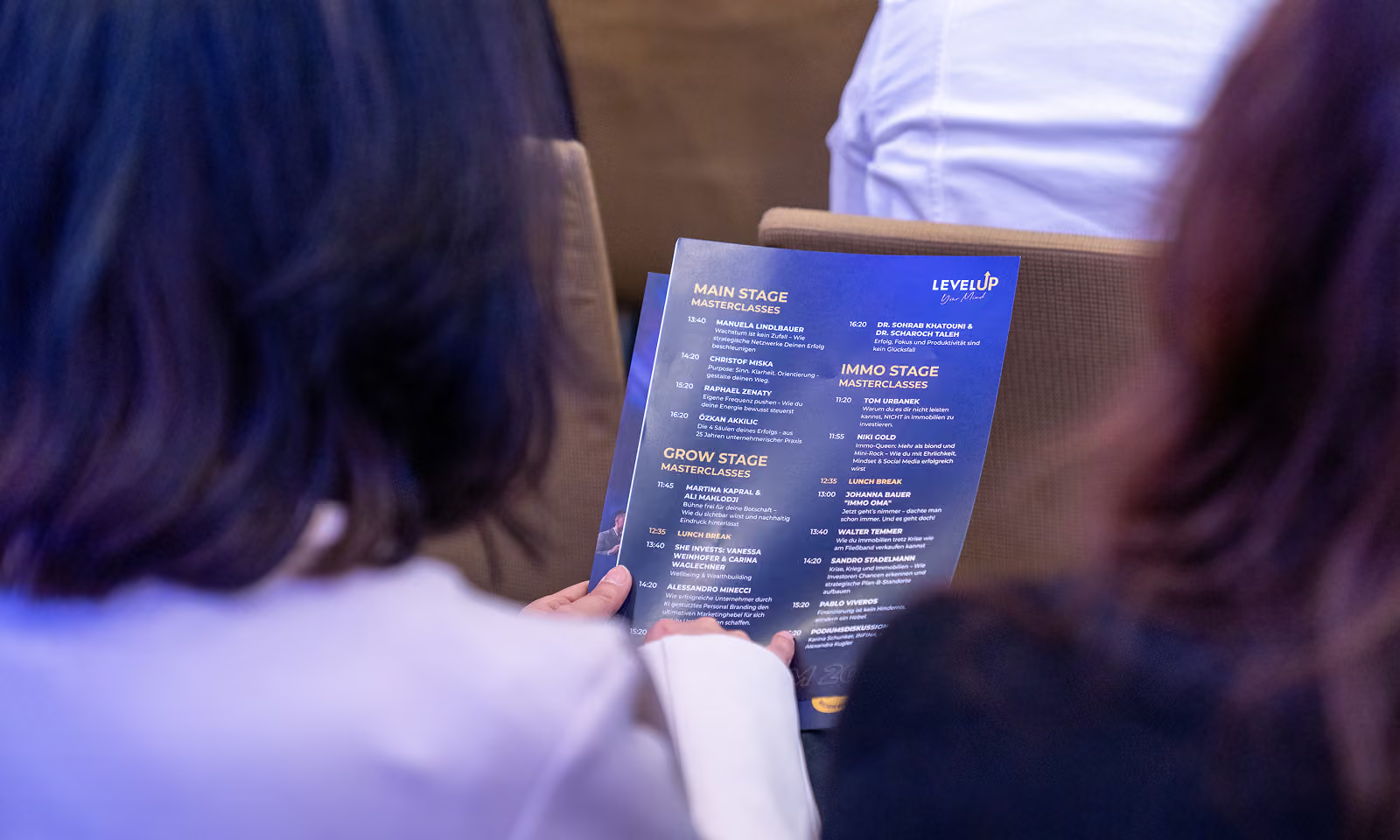
This is how you build an event agenda that measurably increases revenue and motivation
An event agenda is not a schedule.
It is a sales tool.
If your agenda merely strings together program items, you'll get applause for the catering. But no results.
If your agenda is psychologically structured, you'll get leads, motivation, clarity, or revenue.
So the question is not: Which speakers should we book?
The question is: What thought process should your attendees go through?


The Campfire Matrix: How to design events that are memorable and drive more conversions
Many events end up feeling the same. You were there. You ate. You shook a few hands. And two weeks later, no one remembers what it was about.
If you truly want your event to make an impact, you don't need a bigger budget. You need a system that prevents your event from falling apart conceptually.
The Campfire Matrix is exactly that system. It ensures that your event isn't just pleasant, but creates memories and delivers results.
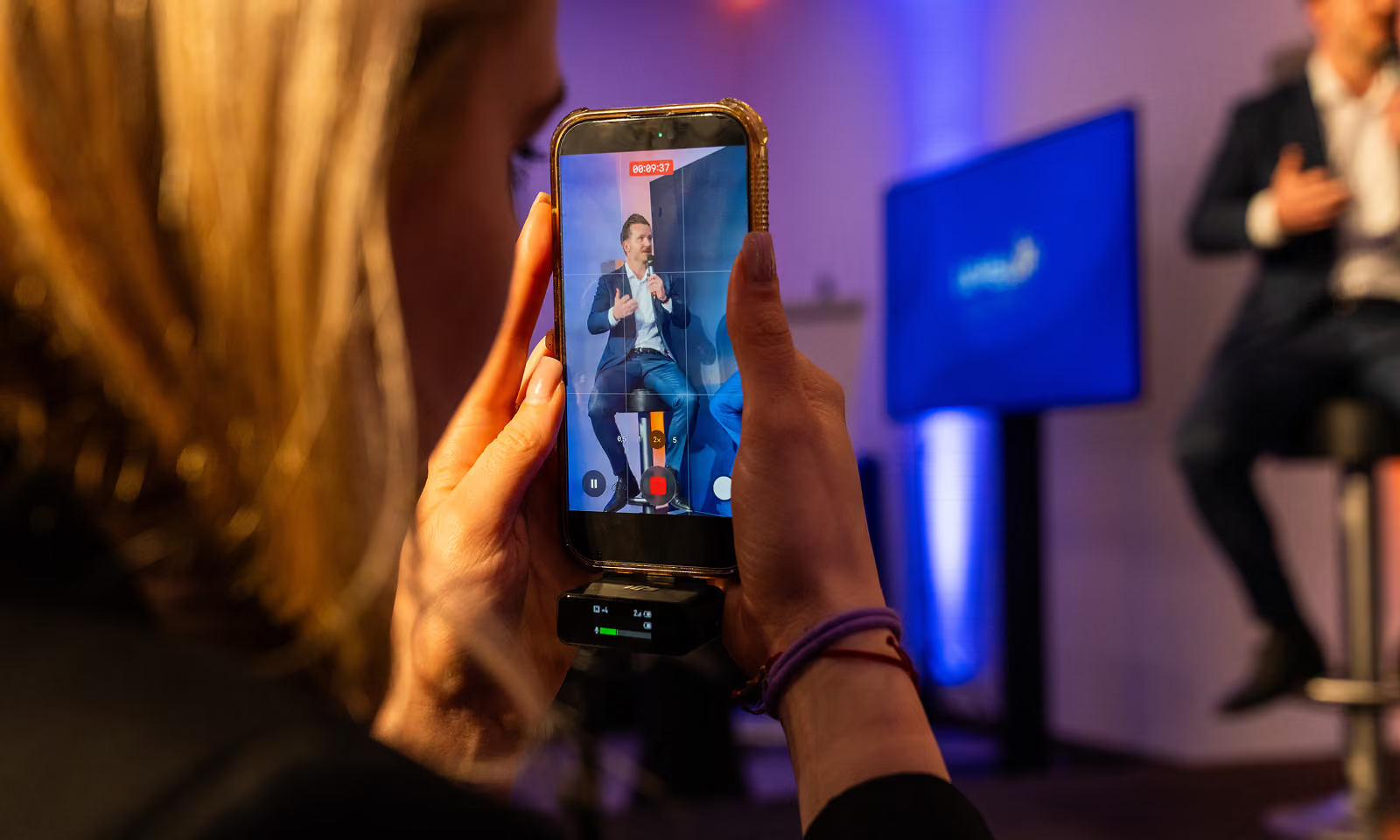
How to turn an event into a content machine: Plan for social media before, during, and after the event
Most companies think of event content as an aftermovie. A nice video, a short-lived peak, and that's it.
The problem: An aftermovie rarely sells tickets, rarely books appointments, and almost never builds trust. It's a memory, but not a machine.
If you use social media correctly, your event becomes a content source for weeks, sometimes months. Before the event for registrations, during the event for reach and FOMO, afterwards for follow-up business, applications, or the next event.
Here's the clear plan.
